
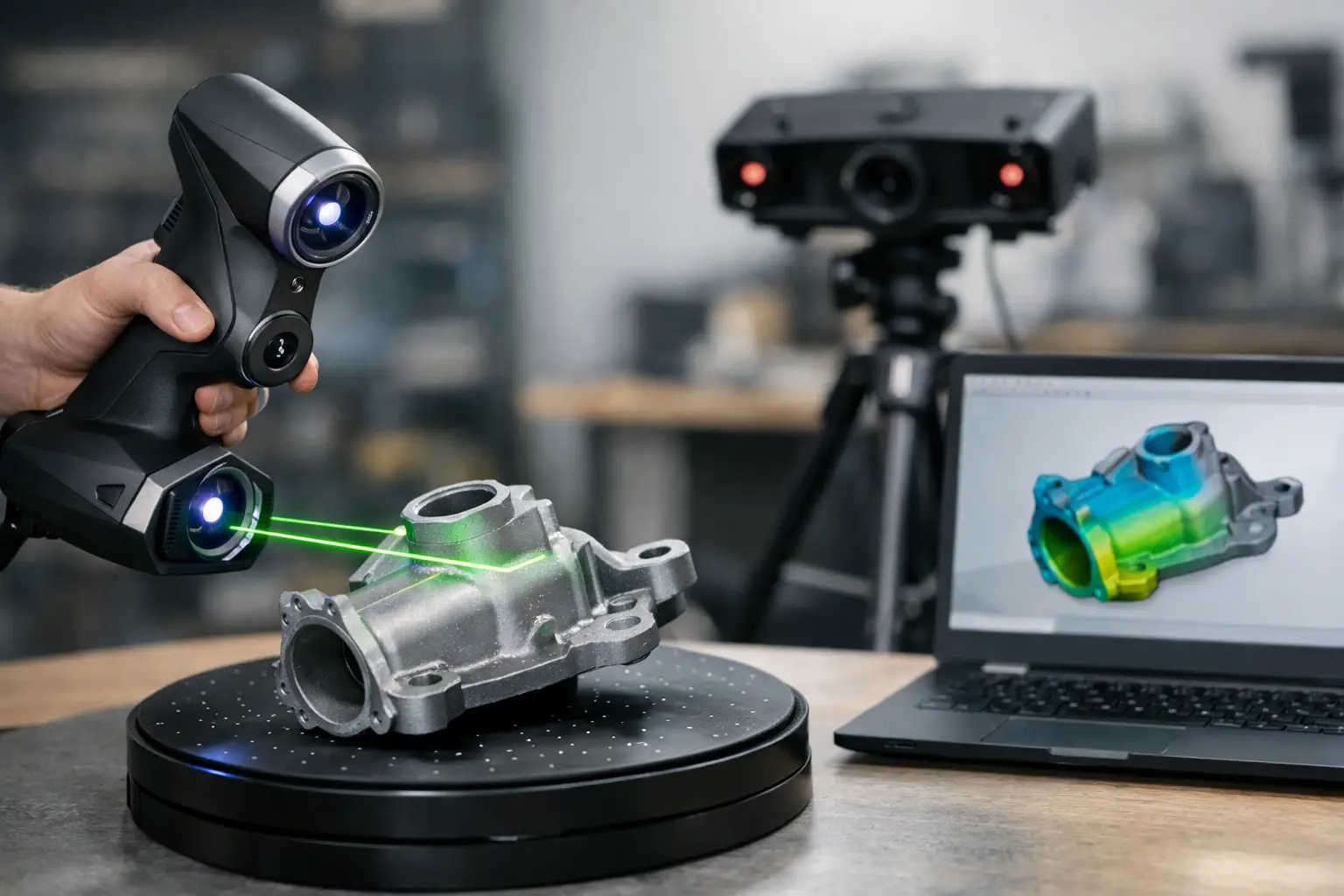
A broken clip on an appliance, a missing cover on a tool, a snapped bracket inside a car – small parts cause big headaches when the original manufacturer no longer sells spares. That is exactly where 3d scanning for replacement parts becomes useful. Instead of guessing dimensions or trying to model a complex shape from scratch, scanning captures the form of the original part so a new one can be recreated with much less trial and error.
For many customers, the problem is not the whole product. It is one plastic piece that failed, wore out, or disappeared. Replacing the entire item can be expensive, wasteful, or simply impossible if the product is discontinued. A scan-based workflow gives you another option, especially for one-off repairs, hobby projects, legacy equipment, and parts with unusual geometry.
What 3D scanning for replacement parts actually does
At its core, 3D scanning measures the shape of an existing object and turns it into digital data. That data can then be cleaned up, adjusted, and used as the starting point for a printable replacement part. This is especially helpful when the original part has curved surfaces, hidden contours, or organic details that would take much longer to measure by hand.
That said, scanning is not magic. A raw scan is usually not ready to print as-is. Most replacement parts still need some design work after scanning. Holes may need to be sharpened, worn edges may need to be restored, and damaged areas may need to be rebuilt based on symmetry or measurements from surrounding features. Good results come from combining the scan with practical CAD work and print experience.
When scanning is the right choice
3D scanning for replacement parts makes the most sense when you have an original part, even if it is damaged, and that part would be difficult or time-consuming to model from scratch. This often includes housings, clips, trim pieces, mounts, knobs, adapters, and covers with compound curves.
It is also useful when speed matters. If someone needs a working replacement quickly, scanning can reduce the modeling time needed to get to a test print. For small businesses, that can mean less downtime on a fixture, holder, or machine accessory. For consumers, it can mean saving a favorite item instead of throwing it away.
The best candidates are parts that are physically available and mostly intact. If the only reference is a broken fragment, the project can still be possible, but more reconstruction is needed. In those cases, the scan becomes one input rather than the full answer.
When scanning is not the best solution
Some parts are faster to redraw from measurements than to scan. Simple spacers, flat brackets, or basic rectangular parts often fall into that category. If a shape is straightforward, CAD modeling from calipers can be cleaner and more efficient.
Material demands also matter. A scan can recreate geometry, but it does not automatically reproduce the original material properties. If the part needs high heat resistance, chemical resistance, or structural strength under constant load, the print material and design approach matter just as much as the scan.
Tolerance is another factor. For decorative or light-duty functional parts, printed replacements can work very well. For high-precision mechanical components, tight-fit assemblies, or safety-critical parts, the process needs much closer review. Sometimes a printed replacement is perfect. Sometimes it is better as a prototype before moving to another manufacturing method.
How the process usually works
A practical replacement-part workflow starts with the original piece. The part is scanned to capture its overall shape and key surfaces. After that, the scan data is cleaned up and converted into a usable model. This is where the real craft comes in.
Wear and damage have to be separated from the intended design. If a latch tab is snapped off, that feature needs to be rebuilt. If a circular hole scanned slightly rough, it may need to be redrawn to the proper dimension. If the original part warped over time, the digital model may need correction before printing.
Once the model is ready, the next step is choosing the right print settings and material. A cosmetic cover might work well in one material, while a clip or bracket may need something tougher and more flexible. Orientation, layer bonding, and wall thickness can make a major difference in how the part performs.
A test fit is often part of the process. Even with a good scan, real-world parts live inside real-world products, and there can be hidden tolerances in the surrounding assembly. One print may reveal that a tab needs a slight adjustment or a mounting hole should be opened up by a fraction. That is normal and often leads to the best final result.
Accuracy matters, but so does interpretation
People often ask how accurate a 3D scan is, but accuracy alone is only part of the story. For replacement parts, what matters is whether the final model fits and functions. A highly detailed scan of a worn-out part can still produce a poor replacement if nobody corrects the wear.
That is why experienced interpretation matters. Scans pick up damage, scratches, and missing chunks along with the useful geometry. A good workflow does not blindly copy all of it. It restores the part to what it was supposed to be.
This is also why personal support helps. If a customer can explain where the part came from, what failed, and how it needs to work, that information improves the result. A replacement hinge pin and a decorative trim cap may both be scanned, but they are not designed with the same priorities.
Common parts that work well with 3D scanning
Many everyday jobs are a strong fit for this process. Appliance knobs, battery covers, vacuum attachments, tool hangers, game or hobby components, custom adapters, and interior trim pieces are all common examples. Small business customers often need jigs, machine guards, mounting parts, and holders that are hard to source or no longer sold.
Older products are especially good candidates. Manufacturers move on, molds are retired, and spare inventories disappear. If the rest of the product still works, recreating one missing piece can extend its life by years.
There is also value in duplication. Sometimes the goal is not repair but making another copy of an existing part for convenience, customization, or short-run use. Scanning gives a head start there too.
What customers should bring to a scanning project
The better the reference, the better the result. An intact original is best, but even a cracked or worn part can be enough if most of the geometry is still present. If there are left and right versions, or mirrored parts from the same assembly, bringing both can help fill in missing details.
Photos of where the part fits are useful too. They help clarify orientation, movement, clearance, and load points. If the part failed under stress, that is worth mentioning. Sometimes a replacement should not just match the original – it should be improved with thicker walls, a stronger fillet, or a better material.
Dimensions from the surrounding product can also speed things up. Even a few key measurements can confirm critical fit areas after scanning.
Why this service is practical for everyday customers
For many people, the barrier is not interest. It is access. They do not own a scanner, they do not know CAD, and they do not want to spend days learning software to replace one broken part. A service-based approach solves that problem.
That is where a hands-on partner makes a real difference. At Wijnbeek 3D, projects like this are about more than making a digital copy. The goal is to help customers get a usable replacement with clear communication, realistic advice, and a process that fits the part instead of forcing the part into a one-size-fits-all workflow.
Some jobs are simple and fast. Others need reconstruction, test fitting, and material guidance. Being honest about that upfront saves time and leads to better parts.
The real value of 3D scanning for replacement parts
The biggest benefit is not just convenience. It is keeping useful products in service when replacement parts are unavailable, overpriced, or never sold separately. That matters for households, hobby setups, workshops, and small businesses trying to avoid unnecessary waste and cost.
It also opens the door to practical customization. Once a part is captured digitally, it can sometimes be adjusted to fit a new use, improved for durability, or adapted around a known weakness in the original design.
If you have a broken part in your hand and no good way to buy another one, scanning may be the step that turns a dead-end problem into a fixable one. Sometimes all it takes is one good reference part and the right set of eyes on the project.
Leave a Reply