
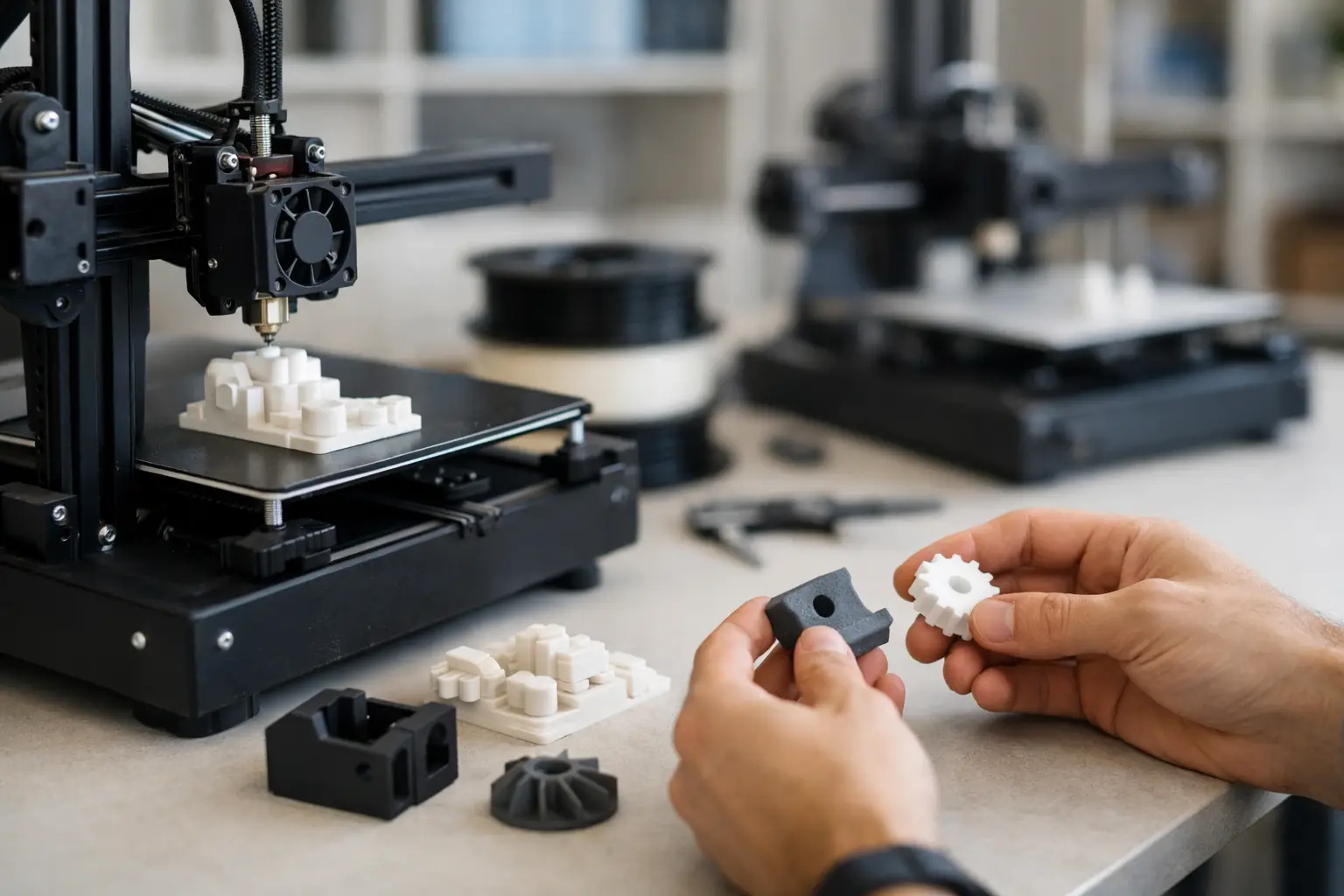
If you need 10 custom brackets, 25 personalized keychains, or a handful of replacement parts that no store carries anymore, mass manufacturing is the wrong tool for the job. A small batch 3D printing service sits in the middle ground between a one-off print and full production, giving you enough volume to be practical without forcing you into large minimum orders.
That matters more than most people expect. Plenty of projects start small on purpose. You may want to test a product before investing in inventory, replace parts for a niche machine, create event items with names or branding, or order a short run of parts for your business without buying equipment and learning the whole production process yourself.
What a small batch 3D printing service actually solves
The biggest advantage is flexibility. Traditional manufacturing usually makes sense when quantities are high and the design is locked in. Small-batch 3D printing works better when you need lower volumes, design freedom, and faster changes.
For a maker or hobbyist, that could mean printing several versions of a part to compare fit and finish. For a small business, it might mean producing 20 to 100 pieces for a market test, internal use, or a limited product run. For a homeowner, it can be as simple as replacing multiple broken clips, knobs, spacers, or covers that are no longer available.
This is also where personal support matters. Many customers know what they need but do not have a ready-to-print file. Others have a file but are unsure whether it will print well, hold up in use, or stay within budget. A good service helps with more than machine time. It helps translate an idea into a part that actually works.
When small batch 3D printing makes sense
Short-run printing is a strong fit when the quantity is too high for casual home printing but too low for injection molding or other factory methods. That range is different for every project, but it often starts when you need enough parts that consistency, turnaround, and repeatability become important.
A few common examples come up again and again. Small businesses use it for product prototypes, packaging accessories, branded promotional items, and custom fixtures. Consumers use it for personalized gifts, home organization pieces, replacement parts, and decorative items. Hobbyists and creators use it for model accessories, cosplay components, enclosures, mounts, and limited-edition designs.
There are trade-offs, of course. If you need thousands of identical parts at the lowest possible unit cost, 3D printing is usually not the best long-term production method. If your part needs highly specialized engineering materials, very tight industrial tolerances, or specific certifications, the answer may depend on the application. But for low-volume production with room for customization, 3D printing is often the practical choice.
What to expect from a good small batch 3D printing service
Not all providers handle small production runs the same way. Some are built for hobby orders and one-off prints. Others are more focused on engineering or large-scale prototyping. If your goal is a short run of reliable parts, you want a service that can balance print quality, communication, and production planning.
The first thing to look for is guidance. If a provider simply accepts files and prints whatever arrives, that can work for experienced users. It is less helpful if you need support with orientation, strength, material choice, or surface finish. A dependable service will tell you when a wall is too thin, when a design might warp, or when a different material would save you money.
The second is equipment capability. Machine quality affects consistency, speed, color options, and how efficiently batches can be produced. That does not mean every project needs the most advanced setup available. It does mean your provider should be able to explain how the equipment supports the result you want.
The third is responsiveness. Small-batch projects often include questions, revisions, and timing needs. If you are ordering parts for a repair, a product launch, or an upcoming event, waiting days for basic answers can become the biggest problem in the whole process.
Design matters more than quantity
One of the biggest misconceptions about 3D printing is that once a model exists, production is easy. In reality, part design has a direct effect on cost, print time, durability, and appearance.
A part designed for 3D printing can often be produced faster and more affordably than a part adapted from another manufacturing method. Features like unnecessary support-heavy overhangs, overly thick sections, or poor tolerances can create delays and extra finishing work. On the other hand, smart design choices can improve strength while reducing material use.
This is why design assistance is so valuable for small-batch work. If you only need a limited run, every revision matters. Fixing a weak snap fit or adjusting a mounting hole before printing 30 pieces is much better than discovering the issue after the batch is complete.
If you do not have a file at all, that is not a dead end. Many useful projects begin with a sketch, a photo, a broken part, or just a description of the problem. A hands-on service can help move that idea into a printable model, and in some cases 3D scanning can speed up the process when an existing object needs to be duplicated or adapted.
Materials, finish, and the real-world trade-offs
A small batch 3D printing service is not just about producing shape. Material selection changes how a part performs and how it feels in use.
For basic visual models, lightweight accessories, or decorative pieces, standard materials may be enough. For brackets, tool holders, functional enclosures, or replacement parts, strength and heat resistance may matter more. If the item will be handled often, surface feel and finish may be part of the decision too.
This is where honest advice beats a generic quote. The cheapest material is not always the best value if it cracks under load or deforms in a warm car. At the same time, a higher-end material is not necessary for every item. A good provider helps match the material to the job instead of overselling complexity.
Color and appearance can matter just as much for consumer-facing projects. Personalized gifts, display pieces, branded merchandise, and decor often benefit from clean finish quality and multicolor capability. Functional parts may prioritize strength first, but even there, neat and consistent prints reflect the care put into the work.
Why small businesses and creators use short-run production
For many small brands, short-run production is less about manufacturing and more about reducing risk. Instead of ordering a large quantity and hoping the market responds, they can test a design in smaller numbers, gather feedback, and improve the next run.
That approach works well for custom accessories, niche tools, hobby products, and specialty items that would never justify a large factory order. It also gives room for variation. You can offer multiple names, sizes, colors, or small design changes without rebuilding an entire supply chain around them.
That is one reason businesses turn to providers like Wijnbeek 3D. The value is not only that parts get printed. It is that the process stays accessible, questions get answered directly, and the final result is treated like a real product, not just a file sent through a machine.
How to know if your project is ready
You do not need perfect technical knowledge before reaching out. What helps most is having a clear goal. Think about what the part needs to do, how many you need, where it will be used, and whether appearance or strength matters more.
If you already have a printable file, great. If not, gather whatever reference you can – dimensions, photos, sketches, or the original object. For replacement parts, even a damaged sample can be useful. For custom items, examples of size, style, and color preferences can speed things up.
The more practical detail you can share early, the easier it is to get useful advice and an accurate quote. That does not mean you need to speak like an engineer. Plain-language project goals are often the best starting point.
A small batch 3D printing service works best when you want something real, useful, and tailored to your project without jumping straight into large-scale manufacturing. If you have an idea, a missing part, or a short run that needs to happen soon, the next step is usually simpler than people think: start the conversation, ask the questions, and let the project take shape from there.
Leave a Reply