
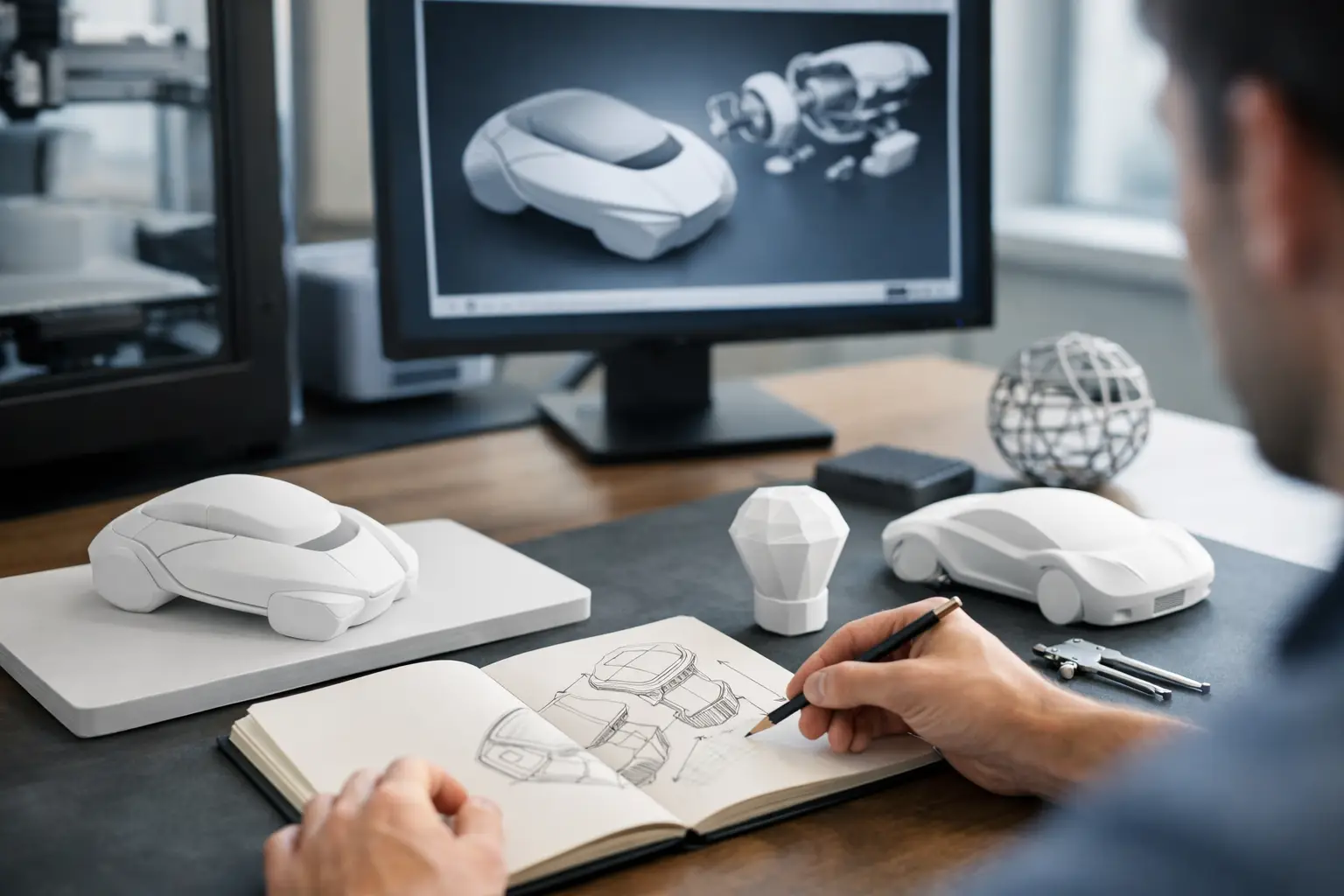
A broken knob, a rough sketch on paper, a product idea you can explain but not model – this is usually where people start looking for 3d design help for ideas. Not because the idea is weak, but because turning a concept into a printable file takes a different skill set than coming up with the concept itself.
That gap is where good design support matters. If you have the idea but not the CAD experience, you do not need to learn complex software just to move forward. You need someone who can take what is in your head, ask the right questions, and turn it into a file that can actually be printed, tested, and improved.
What 3D design help for ideas really means
A lot of people assume 3D design starts with a finished drawing. In practice, it often starts with much less. Sometimes it is a photo of a broken part. Sometimes it is a hand sketch with a few measurements. Sometimes it is just a message that says, “I need this piece to fit here, hold this, and not break.”
Real design help is not just drawing something that looks right on a screen. It is translating your goal into a model that makes sense for manufacturing. That includes dimensions, tolerances, material choice, wall thickness, strength, and how the part will actually print.
This is especially important for replacement parts, one-off tools, branded items, and early prototypes. These projects often sound simple at first, but small details make the difference between a file that prints well and one that wastes time and material.
When you should ask for help instead of modeling it yourself
There is nothing wrong with learning CAD. For some customers, it makes sense. But if your real goal is getting a part made, not becoming a designer, outside help is usually faster and less frustrating.
That is especially true when the project has to fit an existing object, solve a practical problem, or look clean enough to sell or gift. A decorative piece can be forgiving. A replacement latch or bracket usually is not.
You should consider 3d design help for ideas when you have a concept but no file, when your measurements need to be checked, when a broken part needs to be recreated, or when you want to test a product idea without spending weeks learning software first. If the part needs to work on the first or second round instead of the fifth, experienced design input saves money.
The best starting point is often simpler than you think
Many people delay a project because they think they need a polished brief. Usually, you do not. A clear starting point beats a perfect one.
The most useful things you can provide are basic photos, rough dimensions, notes on how the item is used, and what matters most. Does it need to be strong? Flexible? Lightweight? Decorative? Does it need to match an existing part, fit into a specific space, or hold up outdoors?
If you have a damaged original part, that helps. If you only have an idea and a quick sketch, that can still be enough to begin. In some cases, 3D scanning is useful when shape matters more than exact manual measuring, especially for duplicate parts or items with curves and irregular surfaces.
From idea to printable model
The process works best when it is practical and collaborative. First comes the concept stage, where the use case gets clarified. That sounds basic, but it prevents a lot of rework. A part for occasional indoor use will not be designed the same way as a part exposed to heat, force, or repeated movement.
Next comes modeling. This is where dimensions, shape, and printability come together. A good designer is not only thinking about what the object should look like. They are also thinking about how it will be manufactured, where support may be needed, whether certain features are too thin, and how to keep the design cost-effective.
Then comes review. This might involve screenshots, size checks, small revisions, or a first print to test fit and function. For functional projects, revision is normal. A first version might reveal that a clip needs more flex, a hole needs more clearance, or a surface needs to be thicker.
That does not mean the design failed. It means the process is doing its job.
Not every idea needs the same type of design work
This is where expectations matter. A custom keychain, a display piece, and a mechanical replacement part may all be 3D printed, but they are not equally complex.
Simple personalized products are usually quick to design because the structure is straightforward. Nameplates, signs, tags, and small gift items often rely on standard shapes with custom text or artwork.
Functional parts take more attention. A bracket, mount, cap, hinge, or enclosure has to fit, perform, and survive actual use. That means design decisions are tied to material behavior and printer capability, not just appearance.
Product prototypes sit somewhere in the middle. If you are testing shape, fit, or customer interest, a printed prototype can move quickly. If you are testing moving parts or preparing for small-batch sales, the design usually needs more refinement.
Why print knowledge matters during design
This is one of the biggest differences between general 3D modeling and design for 3D printing. A model can look excellent on screen and still be a poor print.
Features that are too thin may snap. Tight tolerances may fuse. Overhangs may need support that leaves marks. Large flat surfaces may warp depending on the material. Multicolor details might require a different approach than a single-color print.
That is why hands-on design help is valuable. The person creating the file should be thinking ahead to the actual production process. This keeps the design realistic, improves reliability, and reduces back-and-forth later.
For customers, it also means better advice. Sometimes the best answer is not adding more detail. Sometimes it is simplifying a shape, thickening a weak point, or changing one feature so the part prints cleaner and lasts longer.
Good design help is part technical, part communication
People often worry they will not know the right words. That is fine. You do not need engineering vocabulary to explain a problem well.
What helps most is describing what the item needs to do and where current options fall short. Maybe the original part is discontinued. Maybe the replacement on the market is overpriced or poorly made. Maybe you need a one-off item with your own branding, size, or style.
A service-oriented design process should make this easy. You explain the problem in plain language, share what you have, and get guidance on what is possible. Sometimes the answer is straightforward. Sometimes there are trade-offs between strength, appearance, speed, and cost.
That honesty matters. A dependable design partner does not overpromise. If a part needs adjustment after the first test print, that should be part of the conversation from the start.
What beginners and small businesses usually get wrong
Beginners often assume they need a final design before asking questions. Small businesses sometimes assume they need to order in volume before custom design becomes worthwhile. Neither is true.
Early questions are useful because they prevent avoidable mistakes. If a logo detail will print poorly at a certain size, it is better to know that early. If a product concept would be stronger with a different geometry or material, that is easier to fix before production.
For small businesses, custom 3D design can be a practical way to test fixtures, packaging inserts, promo items, display pieces, or prototype products without committing to expensive tooling. The right project does not need a huge run to make sense.
A better way to move from concept to object
The real value of design support is not just getting a file. It is getting a path forward. Instead of guessing at software, dimensions, and print settings, you get a process that turns a rough idea into something usable.
That is what makes custom work approachable for both first-time customers and experienced makers. Some people come with a napkin sketch. Others come with exact requirements and only need production. Both can work, as long as the process matches the project.
At Wijnbeek 3D, that hands-on approach is what makes custom manufacturing more accessible. You do not need to have everything figured out before reaching out. You just need a real idea, a practical goal, and enough detail to start the conversation.
If something in your home, workshop, product line, or gift list exists only as a sketch, a broken part, or a “could this be made” question, that is already enough to begin.
Leave a Reply