
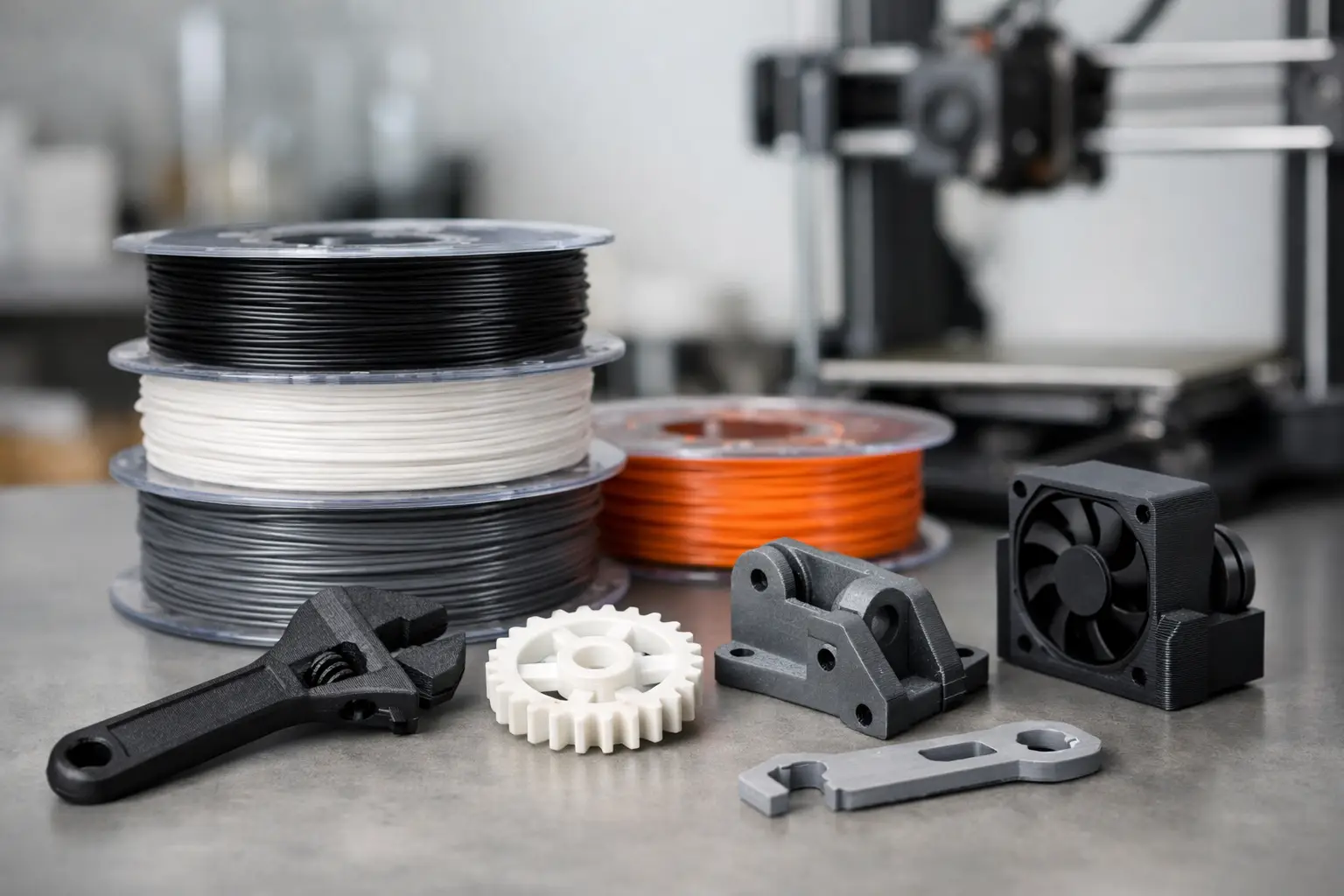
A part that looks great on the bed can still fail the first time you tighten a screw, leave it in a hot car, or clip it into place. That is why choosing the best filament for functional prints is less about what is easiest to print and more about what the part actually needs to do.
For decorative models, you can often prioritize surface finish or color. Functional parts are different. A bracket, spacer, jig, enclosure, replacement knob, or tool holder has to deal with force, heat, wear, impact, or outdoor exposure. In many cases, the right material matters just as much as the design itself.
What makes a filament good for functional parts?
When people ask for the best filament for functional prints, the honest answer is: it depends on the job. Strength is only one part of the picture. A strong material that warps badly may be the wrong choice for a precise part. A filament with great stiffness may crack if the part needs to flex. A material that works well indoors may fail quickly in sunlight or heat.
The real question is which property matters most for your application. Some parts need rigidity so they do not bend under load. Others need impact resistance so they survive drops and repeated use. Some need heat resistance, especially for parts used near motors, electronics, kitchens, cars, or sunny windows. Others need low friction, chemical resistance, or a bit of flexibility.
That is why material selection should start with use case first, printability second, and price third. Saving a few dollars on filament is rarely worth it if the printed part has to be remade.
PLA: good for prototypes, limited for hard-use parts
PLA is often the first material people use, and for good reason. It prints easily, holds detail well, and usually gives predictable results. If you are testing fitment, checking dimensions, or making light-duty parts for indoor use, PLA can still be a sensible option.
But PLA is usually not the best filament for functional prints that need long-term durability. It is relatively stiff, which sounds useful, but it can also be brittle. More importantly, its heat resistance is limited. A PLA part left in a warm car or near a heat source can soften and deform faster than many people expect.
That does not make PLA useless. For drawer organizers, light-duty mounts, alignment jigs, or covers that will not see much stress, it can work well. It is just not the material to trust for clips, mechanical parts under tension, or anything exposed to higher temperatures.
PETG: the practical middle ground
If there is one material that solves a lot of real-world problems without making printing overly difficult, it is PETG. For many users, PETG is the best filament for functional prints because it balances strength, durability, and ease of printing better than most alternatives.
PETG is generally tougher than PLA and less brittle. It also handles heat better and has good chemical and moisture resistance for many household and workshop uses. That makes it a strong choice for brackets, enclosures, machine guards, utility hooks, cable management parts, and replacement components.
Its trade-offs are worth understanding. PETG can be a little stringy, and it is not always the cleanest option for sharp overhangs or tiny cosmetic details. It can also flex more than PLA, which is helpful in some parts and annoying in others. If you need a very rigid component with minimal movement, PETG may feel slightly too forgiving.
Still, for many general-purpose functional parts, PETG is where material choices start making practical sense.
ABS and ASA: better for heat and tougher environments
ABS has been a standard functional plastic for years because it offers better heat resistance and impact performance than PLA. It is often a better match for parts that need to survive more demanding service conditions, especially indoors where temperatures may rise.
The challenge with ABS is printing it well. It tends to warp, and it prefers a controlled environment. If a printer is not set up for it, results can be inconsistent. That matters because a material is only useful if it can be printed accurately and repeatably.
ASA is similar to ABS in many ways but adds better UV resistance, which makes it especially useful for outdoor applications. If a part will live in sunlight, on a vehicle, near a window, or outside in changing weather, ASA is often the smarter choice. It is commonly used for covers, housings, signage components, and outdoor brackets.
Between the two, ASA is often the better modern option for practical outdoor parts, while ABS still makes sense for indoor components that need better heat resistance than PETG or PLA can offer.
Nylon: excellent toughness, but not the easiest path
Nylon is one of the strongest candidates for heavily used mechanical parts. It is tough, wear-resistant, and better than many common filaments when it comes to repeated stress. Bushings, hinges, clips, gears in light-duty applications, and parts that need to absorb impact can benefit from nylon.
This is where the usual advice gets oversimplified. Nylon is not automatically the best filament for functional prints just because it is strong. It also absorbs moisture from the air, which can affect print quality. It can be harder to print consistently, and some nylon blends are better suited to printing than others.
Another trade-off is stiffness. Nylon is tough, but it is not always rigid. If your part needs to resist bending completely, nylon may flex more than expected. In those cases, a stiffer material or a design change may be the better move.
For advanced functional parts, nylon is excellent. For everyday users, it is often a material worth choosing only when the part clearly needs what nylon does best.
TPU: the right choice when flexibility matters
Not every functional print should be rigid. TPU is a flexible filament used for parts that need grip, compression, vibration damping, or shock absorption. Feet, bumpers, protective sleeves, flexible couplings, cable strain reliefs, and gaskets are common examples.
TPU is not the best all-around filament for functional prints, but it is the best answer for applications where flexibility is the feature, not the problem. A rigid plastic would fail quickly in these roles.
The main consideration is design intent. TPU works well when the part is meant to bend or cushion. If the part is supposed to hold shape under load, TPU is usually the wrong material.
Matching the material to the part
The fastest way to choose well is to think through the working conditions. If the part is a simple indoor utility item with low stress, PLA may be enough. If it needs better toughness and day-to-day durability, PETG is often the safe starting point. If it will face heat, ABS or ASA becomes more attractive. If it must handle repeated stress, wear, or impact, nylon deserves a closer look. If it needs to flex, TPU is the obvious fit.
That sounds simple, but design still plays a major role. Layer orientation, wall count, infill, and part geometry can change the outcome dramatically. A poorly designed nylon part can fail faster than a well-designed PETG part. Material choice helps, but it cannot rescue weak geometry.
This is also why some functional jobs are better handled as a service instead of a trial-and-error hobby exercise. If the part solves a real problem, like replacing a broken component or producing a usable small-batch part, it helps to pair the right material with the right print setup from the start.
So what is the best filament for functional prints?
For the widest range of real-world uses, PETG is often the most practical answer. It is durable, reasonably strong, more heat resistant than PLA, and accessible enough for common functional parts. If someone needs one material that covers a lot of ground without too much hassle, PETG is usually the best place to begin.
But that is not the same as saying PETG is always best. Outdoor parts often lean toward ASA. Mechanical wear parts may benefit from nylon. Flexible components clearly point to TPU. Heat-sensitive environments may rule out PLA immediately.
The best choice comes from matching the material to the demands of the part, not from picking the most popular filament on a chart. At Wijnbeek 3D, that is often the difference between a part that merely prints and a part that actually works.
If you are deciding between materials, think less about what prints easiest and more about where the part will live, what it will touch, and how it can fail. That approach usually leads to better parts the first time.
Leave a Reply