
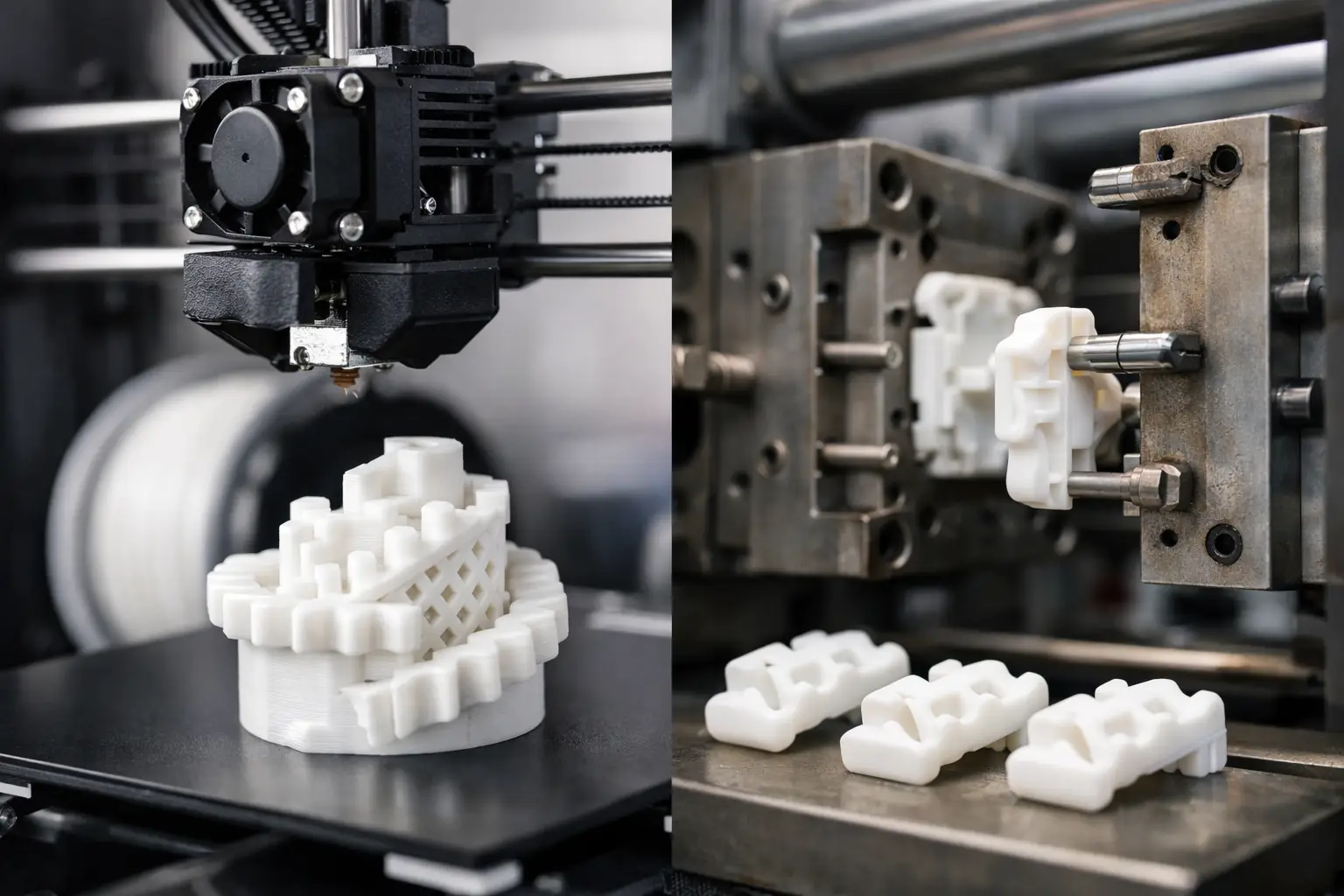
If you need a part made, the real question usually is not whether it can be manufactured. It is which process makes the most sense for your timeline, budget, and quantity. That is where 3d printing vs injection molding becomes a practical decision, not just a technical one.
For some jobs, 3D printing is the clear winner. For others, injection molding pays off fast. The right choice depends on how many parts you need, how quickly you need them, how much customization matters, and what level of finish or material performance the product requires.
3D printing vs injection molding: the basic difference
3D printing builds a part layer by layer from a digital file. That makes it ideal for one-off parts, prototypes, and short runs where flexibility matters. If you need to adjust a design, you update the file and print again.
Injection molding works differently. A mold is created first, and molten plastic is injected into that mold to produce the same part over and over. It takes more setup, more tooling, and more upfront investment, but once production is running, each part becomes much cheaper at scale.
That basic difference shapes everything else – cost, speed, design freedom, surface finish, and production volume.
When 3D printing makes more sense
3D printing is often the better option when speed and flexibility matter more than mass production pricing. If you are testing an idea, replacing a broken part, or making a custom item, you usually do not want to pay for tooling before you know the design is final.
This is especially true for hobbyists, small businesses, and product developers working through early versions. A printed prototype lets you check fit, function, and appearance before committing to a larger production method. If something needs to change, that is usually a simple design revision rather than a tool remake.
Customization is another big advantage. If every item needs a different name, shape, fit, or detail, 3D printing handles that well. Personalized gifts, branded accessories, replacement parts for older products, and low-volume specialty components are all strong use cases.
Lead time is often shorter too. You can move from file to physical part quickly, especially for low quantities. That can be a major benefit when a customer needs a practical solution now, not after weeks of tooling and setup.
When injection molding is the better fit
Injection molding starts to make more sense when you need larger quantities of the exact same part. Once the mold is made, production is fast, repeatable, and cost-efficient on a per-part basis.
That matters for retail products, packaging components, and any item that needs to be produced in the hundreds, thousands, or more. The upfront tooling cost can be significant, but when spread across a large production run, the economics improve quickly.
Injection molding also tends to offer more consistency across big batches. If your product needs highly repeatable dimensions and a uniform appearance from unit to unit, molding has an advantage. It is built for stable, repeatable output at scale.
For finished products headed straight to market, especially in higher volume, injection molding is often the production method that makes commercial sense.
Cost is where most decisions get made
In a straight comparison of 3d printing vs injection molding, cost is usually the deciding factor. But cost only makes sense when you look at both upfront and long-term expenses.
With 3D printing, the startup cost is low. There is no mold to pay for, and that makes it attractive for one part, ten parts, or even a few dozen depending on the design. You are mainly paying for material, machine time, and any finishing work.
With injection molding, the upfront cost is the hurdle. Tooling can be expensive, especially for more complex parts. That means it rarely makes sense for very small runs. But after that initial investment, the per-unit cost drops sharply.
This is why there is no universal winner. If you need 5 custom brackets, 3D printing is almost always the practical choice. If you need 5,000 identical housings, injection molding is likely the better financial decision.
There is also a middle ground where projects can go either way. A short production run might still favor 3D printing if the design changes are likely or if the product needs variation. On the other hand, a stable design with predictable demand may justify molding sooner.
Speed depends on what stage you are in
If your goal is to get a first version in hand quickly, 3D printing usually wins. You can move from concept to prototype fast, test the result, and make changes without restarting an expensive process.
That speed is valuable in product development. It helps you validate ideas before putting money into tooling. For replacement parts or custom requests, it can also mean solving a problem in days instead of waiting through a longer manufacturing setup.
Injection molding is slower at the beginning because the mold has to be designed, manufactured, and tested. That setup stage takes time. But once production is live, molding can produce large numbers of parts very quickly.
So the answer changes depending on the stage. Early development and low-volume work often favor 3D printing. Established products with steady demand often favor injection molding.
Design freedom and customization
This is one area where 3D printing stands out. Complex geometries, internal channels, organic shapes, and one-off modifications are often much easier to produce with additive manufacturing. You are not designing around mold release and tooling constraints in the same way.
That freedom can reduce development friction. It lets makers and small businesses experiment more easily, especially when they are solving niche problems or creating products that would never justify a dedicated mold.
Injection molding has design limitations that come from the tooling itself. Draft angles, parting lines, wall thickness control, and mold complexity all affect what is practical. Good molded part design is efficient, but it requires planning around the manufacturing method from the start.
If your product needs frequent design updates or personalized variations, 3D printing is usually easier to work with. If your design is finalized and optimized for scale, injection molding becomes more attractive.
Surface finish, strength, and material choice
People often assume injection molding is automatically better in quality. That is not always the right way to look at it.
Injection molding typically gives you a smoother, more uniform finish right out of the tool. For consumer-facing products, that can be a major advantage. It also offers access to a wide range of production plastics used in commercial manufacturing.
3D printing can still produce high-quality parts, but the result depends heavily on the technology, material, print orientation, and post-processing. Some printed parts show layer lines, while others can be finished to look much more refined. Strength can also vary based on how the part is designed and printed.
What matters most is whether the part performs well for its actual use. A custom bracket, display piece, prototype enclosure, or replacement component may work perfectly as a printed part. A product expected to withstand high-volume commercial use, strict material requirements, or a premium molded finish may be better suited to injection molding.
The real decision is volume plus certainty
A good way to think about this is simple. 3D printing works best when volume is low and uncertainty is high. Injection molding works best when volume is high and the design is stable.
If you are still testing demand, still refining dimensions, or still deciding what customers actually want, 3D printing gives you room to move. If you already know the product sells and the design is locked in, injection molding may be the smarter next step.
That is why many products use both methods at different stages. A business might prototype and validate with 3D printing, then shift to injection molding later. That is not a compromise. It is often the most efficient path.
Which one should you choose?
If you need a one-off part, a small batch, a customized item, or a fast prototype, 3D printing is usually the better fit. It keeps risk lower, lead times shorter, and design changes manageable.
If you need a large run of identical parts and you are confident the design is final, injection molding is usually the stronger production choice. The upfront investment is higher, but the per-part cost and repeatability can make that worthwhile.
For many customers, the smartest move is to start smaller than they think. Test the design, confirm the fit, and make sure the part solves the real problem before committing to tooling. That is especially true for practical replacement parts, custom products, and new ideas that still need some hands-on refinement.
If you are not sure which path fits your project, that is normal. The best manufacturing decisions usually come from looking at the actual part, the quantity, and the goal – not from forcing every job into the same process. A good part starts with a clear use case, and the right production method follows from there.
Leave a Reply