

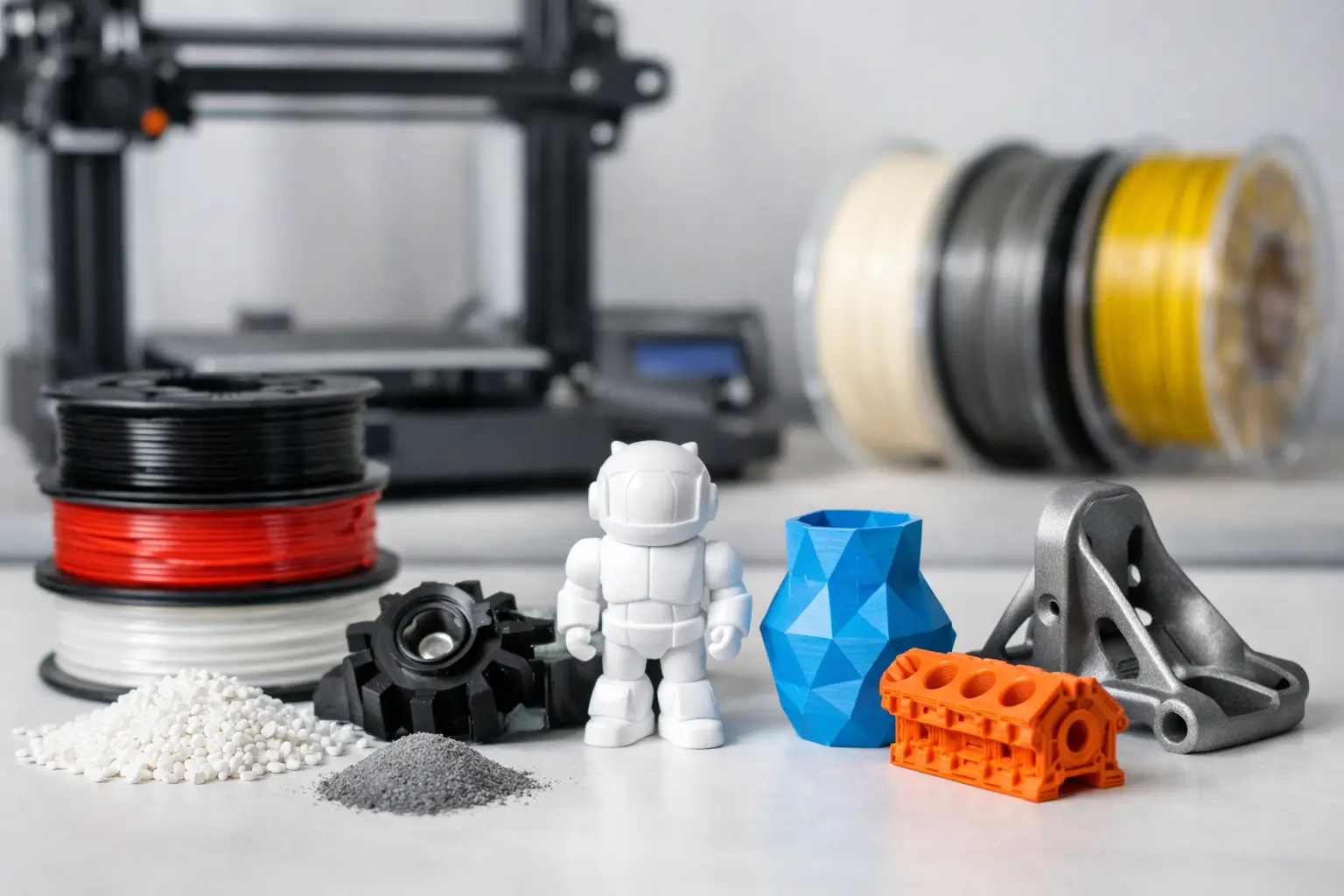
A print can look perfect on screen and still fail in real life if the material is wrong. That is why any useful guide to 3D print materials has to start with the job the part needs to do, not just the color or the price.
Some parts need stiffness. Some need flexibility. Some need to survive heat in a car, outdoor weather, or repeated handling. And sometimes the best-looking material is not the best-performing one. If you are ordering a custom part, replacing something broken, or planning a product prototype, choosing the right material early saves time, money, and frustration.
A practical guide to 3D print materials
The easiest way to choose a material is to ask four simple questions. Will the part be decorative or functional? Will it stay indoors or outdoors? Does it need to bend, resist heat, or hold weight? And does surface finish matter more than raw toughness?
Those answers narrow the field quickly. Most customer projects land in a small group of common materials, and each one has clear strengths as well as a few limitations.
PLA for easy, clean-looking parts
PLA is often the first material people hear about, and for good reason. It prints cleanly, holds detail well, and works nicely for display pieces, light-use parts, organizers, signs, decorative items, and quick prototypes. If you want a crisp result with a wide range of colors and a predictable finish, PLA is usually a strong starting point.
The trade-off is durability under stress and heat. PLA can soften in warmer environments, especially inside a car or near heat sources. It is also more brittle than tougher plastics, so snap-fit parts or heavily loaded brackets may crack rather than flex. For indoor decorative products, though, PLA is often exactly the right answer.
PETG for everyday functional use
PETG sits in a sweet spot for many practical projects. It is tougher than PLA, handles moisture better, and generally offers better impact resistance. That makes it a good fit for utility parts, housings, holders, covers, containers, and general-purpose replacement components.
It is also a sensible option when a part may see occasional outdoor use or damp conditions. PETG does not have the same easy cosmetic finish as PLA in every case, but it makes up for that with better durability. If a customer says, “I need this part to actually be used,” PETG is often where the conversation goes next.
ABS and ASA for heat and tougher environments
ABS has been around for a long time because it offers good strength and better heat resistance than PLA. It works well for mechanical parts, enclosures, and components that need to tolerate a bit more abuse. That said, ABS can be trickier to print well, and getting consistent results depends on the right machine setup.
ASA is closely related and is often the better choice when outdoor exposure matters. It offers similar practical performance with improved UV resistance, which helps for parts used in sunlight. If you need something for a garden fixture, an exterior mount, or a car-adjacent application, ASA is usually worth considering over standard ABS.
The real caution with both is that they are not automatically the best choice just because they sound more industrial. If the part does not need heat resistance or outdoor durability, PETG or PLA may do the job more simply and at lower cost.
TPU for flexible and shock-resistant parts
TPU is the material to consider when rigid plastic is the problem. It is flexible, grippy, and resistant to impact, which makes it useful for gaskets, bumpers, sleeves, protective covers, feet, and soft-touch components.
What matters here is the degree of flexibility needed. Some parts need a rubber-like feel, while others only need a little give to absorb shock or improve fit. TPU can solve problems that hard plastics cannot, but it is not ideal for every geometry. Very thin features may behave differently than expected, and parts that need strict dimensional rigidity are usually better made in something else.
Resin for fine detail and smooth surfaces
Resin printing is a different category from standard filament printing. It shines when surface detail, sharp edges, and a smoother finish are the priority. That makes it popular for miniatures, display pieces, jewelry concepts, dental models, and highly detailed prototype work.
But resin is not automatically stronger. Some resins are brittle, and even tougher formulas have different behavior than common filaments. If the part will be handled carefully and visual quality matters most, resin can be excellent. If the part needs to take repeated mechanical stress, another material may be the better fit.
How to choose the right 3D print material
A good guide to 3D print materials should make one thing clear: there is no universal best material. There is only the best material for your use case.
If you are printing a decorative item, a personalized gift, or a shelf display, PLA is often the most practical option. It gives a clean result and keeps costs reasonable. If you are replacing a broken bracket, making a jig, or creating a part that will be handled often, PETG may be the smarter move.
If the part will sit in the sun, stay in a hot garage, or live near an engine bay, heat and UV resistance matter more than appearance alone. That is where ASA or ABS start to make more sense. And if your part needs to flex, seal, cushion, or grip, TPU is usually the conversation to have first, not last.
This is also where wall thickness, infill, and print orientation matter. A weak part is not always caused by bad material choice. Sometimes the material is fine, but the part design needs reinforcement or the print needs to be oriented differently for strength. That is why real project support matters, especially for custom work.
Surface finish, strength, and cost rarely peak together
One of the most common misunderstandings in 3D printing is expecting the strongest material to also be the cheapest and the prettiest. Usually, you pick two out of three.
PLA often gives a very nice appearance at a lower cost, but it is not the best for heat. PETG improves functional performance, though the finish may be a bit less crisp depending on the part. Resin can produce beautiful detail, but cost and durability may not line up with rough everyday use.
That does not mean compromise is a bad thing. It just means material choice is about priorities. A garage tool holder and a collectible figure should not be judged by the same standard, even if both come off a 3D printer.
Common mistakes people make when choosing materials
The biggest mistake is choosing based on buzzwords instead of use. “Strong” is not specific enough. A part can need tensile strength, impact resistance, flexibility, weather resistance, or heat resistance, and those are not the same thing.
Another common issue is overlooking environment. A part that works perfectly indoors may warp or degrade outdoors. A replacement piece near a dishwasher, heater, or dashboard may fail even if it looks solid on day one.
There is also a tendency to overbuild. Not every simple household part needs an engineering-grade plastic. In many cases, a straightforward material with a smart design gives the best value. At Wijnbeek 3D, that practical matching process is often what keeps projects efficient while still delivering a part that lasts.
When you should ask for help instead of guessing
If you already have a file, material selection is still worth a second look before printing. If you do not have a file yet and only have a broken part, sketch, or idea, getting advice early is even more useful. Small changes in geometry, wall thickness, or material can make the difference between a part that works once and one that keeps working.
This is especially true for replacement parts and custom products. A clip, latch, mount, knob, or housing may seem simple, but real-world use puts stress in very specific places. A hands-on review often catches issues before the print starts.
The best material choice is usually not the fanciest one. It is the one that fits the job, prints reliably, and gives you the performance you actually need. If you are unsure, start with the use case, not the material name, and the right answer gets a lot easier.
Leave a Reply