
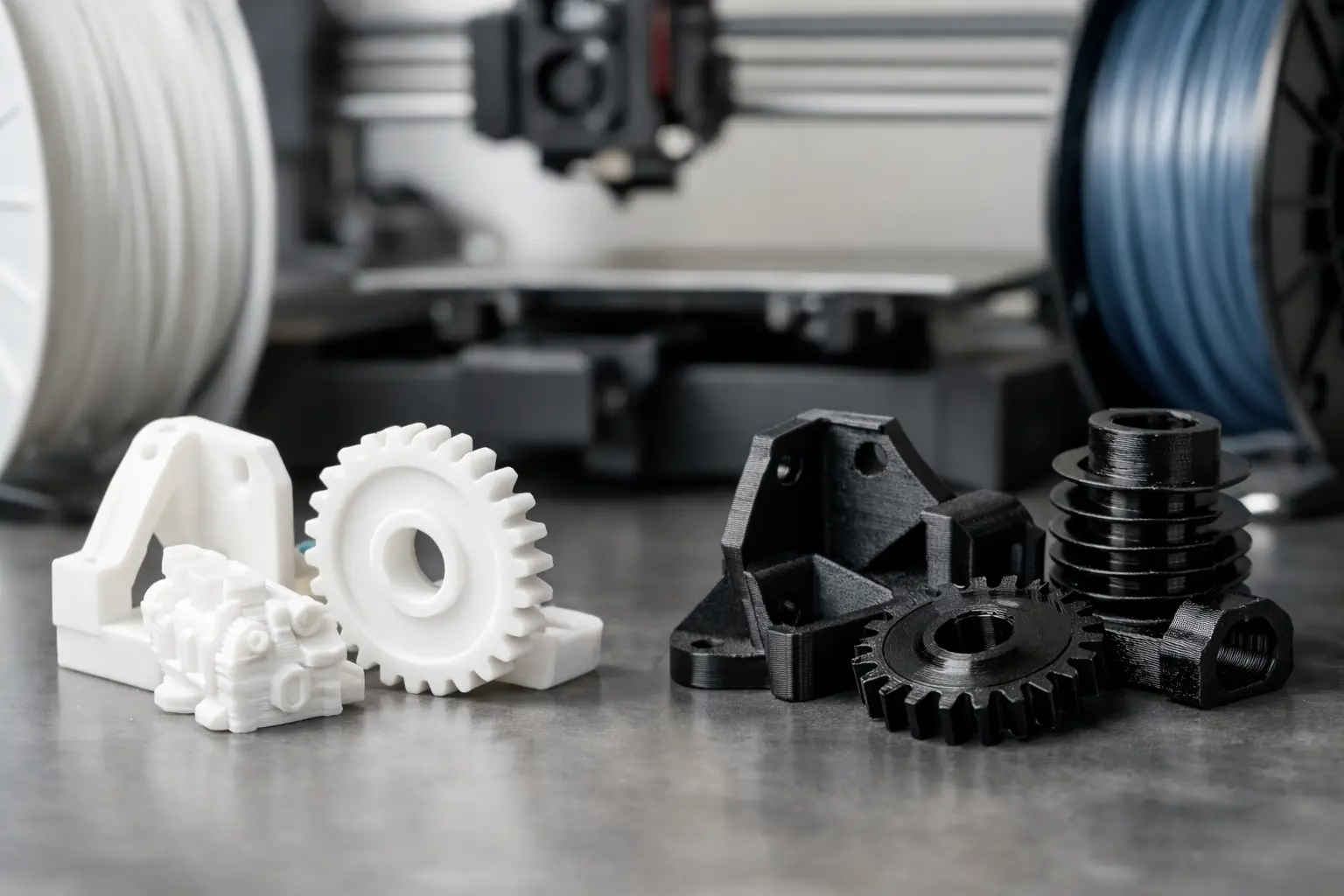
A part that looks perfect on the printer bed can still fail in real use. That is usually where the PLA vs PETG for custom parts question starts to matter – not when you are picking a filament color, but when the part has to handle heat, pressure, flex, or daily wear.
If you are ordering a replacement clip, a prototype housing, a bracket, or a one-off tool, material choice changes the result more than most people expect. PLA and PETG are both popular for good reasons, and neither is simply the “better” option. The right choice depends on what the part needs to do after printing.
PLA vs PETG for custom parts: the short answer
PLA is often the best fit when you want clean detail, a crisp finish, fast production, and a lower-cost part that will live indoors under normal conditions. PETG is usually the safer choice when the part needs more toughness, better impact resistance, or more tolerance to heat and moisture.
That sounds simple, but real projects are rarely that neat. A custom part might need to look good, fit precisely, and survive occasional rough handling. That is where trade-offs matter.
When PLA makes the most sense
PLA is often the first material people hear about in 3D printing, and that reputation is deserved. It prints with excellent dimensional accuracy, produces sharp details, and tends to give a smoother, more polished appearance right off the machine. For decorative pieces, mockups, fit-check prototypes, and light-duty functional parts, it is a strong option.
If you need a replacement cap, a small desk organizer insert, a display component, a jig for light workshop use, or a custom enclosure that stays indoors, PLA can do the job very well. It is also a smart choice when budget matters and the part does not need to handle high temperatures or repeated impact.
One reason PLA works so well for custom jobs is predictability. It is easier to print consistently, which helps when a part needs tight tolerances or fine text and surface features. If someone sends over a file for a one-off part and wants it produced quickly with a clean finish, PLA is often the straightforward answer.
PLA strengths in real-world use
PLA shines when appearance and precision matter most. It holds edges well, which helps with snap-fit geometry, logos, labels, and visible surfaces. It also tends to warp less during printing, which improves reliability for parts that need to match a specific shape.
For customers who need prototypes before committing to a final design, PLA is often the most efficient starting point. It keeps cost down and gives a very accurate representation of size, fit, and overall form.
Where PLA falls short
PLA is more rigid than PETG, but that does not automatically mean it is better for mechanical parts. Rigid materials can crack when stressed, especially if the part is thin or sees repeated force. PLA also softens at relatively low temperatures, so a part left in a hot car, near a sunny window, or close to a warm appliance can deform.
That is why PLA is not usually the first pick for outdoor pieces, load-bearing brackets, or parts that may be bumped, flexed, or heated during normal use.
When PETG is the better choice
PETG sits in a useful middle ground. It is tougher than PLA, less brittle, and generally better suited for functional parts that need to survive real handling. If a part may get dropped, pressed, clipped into place, or used in a garage, workshop, kitchen, or semi-outdoor setting, PETG is often worth the upgrade.
This is the material many people choose when they want a part that feels less like a display item and more like a practical product. It has a little more give before failure, which can make a big difference in clips, covers, guards, mounts, and replacement components.
PETG also handles moisture better than PLA, making it a stronger option for parts used around sinks, bathrooms, utility areas, or other damp environments. It is not indestructible, but it gives you more room for real-world use.
PETG strengths in real-world use
The biggest advantage of PETG is toughness. If your custom part needs to take occasional knocks or flex slightly without cracking, PETG usually performs better. It also has higher heat resistance than PLA, which matters for parts used in warmer rooms, near electronics, or anywhere heat buildup could become a problem.
For small business customers ordering fixtures, spacers, tool holders, or custom machine accessories, PETG often provides a better balance of durability and printability than basic PLA.
Where PETG can be less ideal
PETG is not perfect either. It can be a little less crisp in fine detail than PLA, and the surface finish may not look quite as sharp on some models. Depending on geometry, PETG can also be stringier during printing, which means the printing process has to be well tuned to get the best result.
It is also usually a bit more expensive than PLA. That difference is often justified for functional parts, but not always. If a part is mostly visual, lightly used, and not exposed to stress or heat, PETG can be more material than the job really needs.
PLA vs PETG for custom parts by use case
The easiest way to choose is to think less about the filament itself and more about the life your part will have.
For visual models, indoor organizers, display pieces, concept prototypes, and low-stress replacement parts, PLA is often the practical winner. It looks great, prints cleanly, and keeps costs reasonable.
For brackets, clips, mounts, housings, guards, workshop accessories, and parts that may be handled often or exposed to warmth, PETG is usually the safer choice. It gives you more durability and fewer surprises once the part leaves the printer.
There are also middle-ground jobs where either material could work. A custom electronics case for indoor use might print beautifully in PLA, but if it sits near components that generate heat, PETG may be the better long-term call. A replacement knob might be fine in PLA if it sees light use, but PETG would make more sense if it gets twisted firmly every day.
Appearance, fit, and feel
For many custom parts, performance is not the only goal. The part also needs to look right and fit right.
PLA usually has the edge in visual finish. It can produce sharper corners and cleaner cosmetic detail, which is useful for customer-facing products, personalized items, and prototypes shown to clients. If your project includes embossed names, decorative features, or a polished presentation, PLA often helps deliver that neat final look.
PETG tends to feel tougher in the hand. It can have a slightly glossier or more utilitarian appearance depending on the print settings and color. For practical parts, that is rarely a drawback. In fact, many customers prefer that more durable feel when they want something that works hard rather than simply looks good.
Cost versus long-term value
It is tempting to pick the lower-cost material every time, especially for one-off custom work. Sometimes that is exactly the right move. If the part does not need extra strength or heat resistance, PLA can save money and still give an excellent result.
But replacing a failed part costs more than choosing the right material at the start. If there is a good chance the part will be stressed, flexed, or used in a warm environment, PETG often offers better value because it reduces the risk of cracking or warping later.
This is where honest material advice matters. A cheaper print is only a better deal if it stays useful.
The questions worth asking before you print
Before choosing between PLA and PETG, think about where the part will live, how often it will be handled, and what happens if it fails. Will it sit indoors on a shelf, or in a car, garage, or kitchen? Does it need to snap into place, support weight, or survive repeated use? Is appearance the main goal, or does function come first?
Those answers usually point to the right material quickly. If the project is mostly about detail, presentation, and accurate fit, PLA is often the smart pick. If the part needs a little toughness and heat resistance for day-to-day use, PETG usually earns its place.
For custom printing, the best material is the one that matches the job, not the one with the most hype. That is why hands-on guidance matters. At Wijnbeek 3D, many of the best results come from a simple conversation about how the part will actually be used. A few practical details upfront can save time, cost, and frustration later.
If you are unsure, the safest approach is to describe the part’s real working conditions as clearly as possible. A good print starts with good information, and the right material choice turns a nice-looking part into one that keeps doing its job.
Leave a Reply